Scene-by-scene plotting for novelists

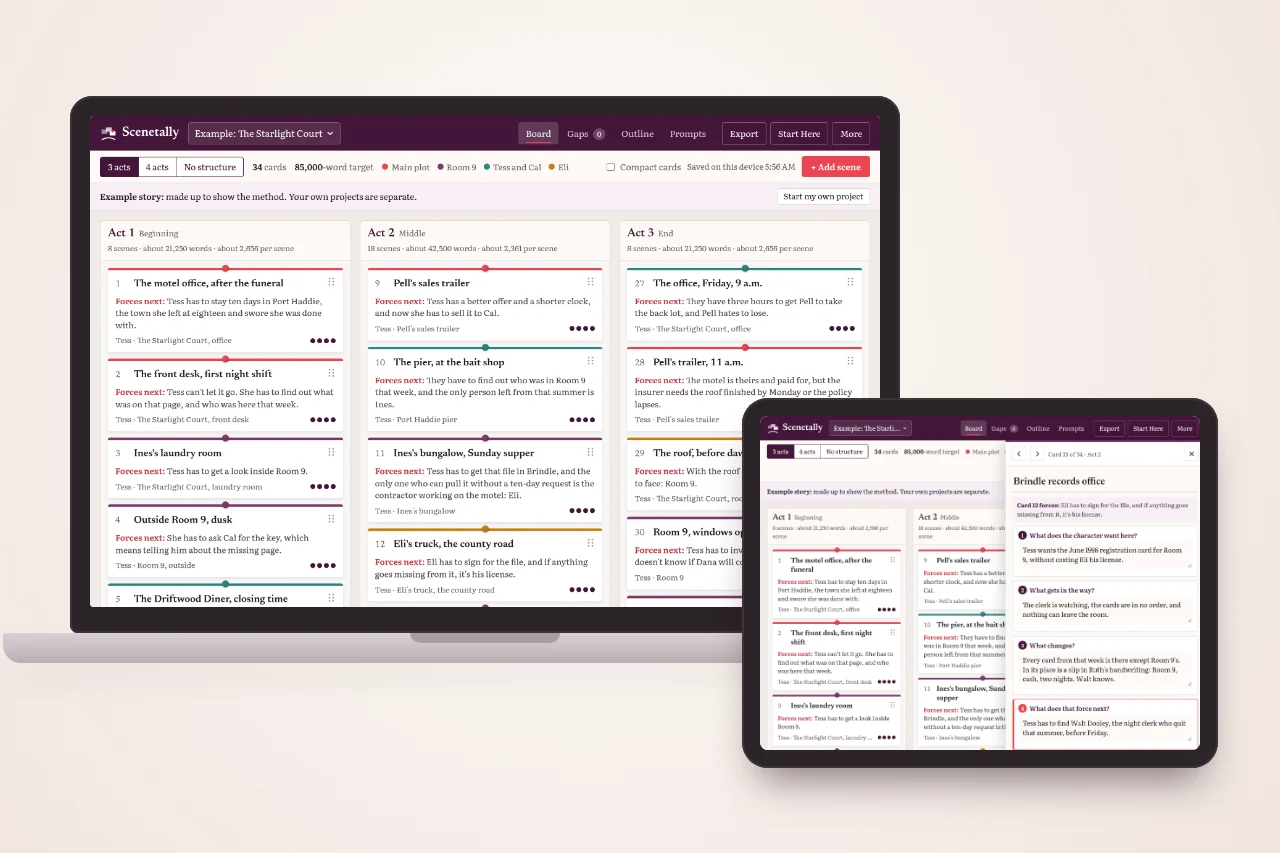
Turn your story idea into a scene-by-scene outline where every scene sets up the next. Each scene card asks four questions: what the character wants, what gets in the way, what changes, and what that forces next. Use 3 acts, 4 acts or no structure at all, and change it anytime. Start from a fully plotted example story.
Scenetally helps you plan your story. It doesn't write it, use AI, or review your manuscript.
You've got the opening. You can see the last chapter. You probably know two or three scenes in between, the ones that made you want to write this book in the first place.
Then there's the stretch between them.
You've plotted it already, maybe several times. Three acts, a list of beats, a wall of sticky notes. Each time, the middle fills up with scenes that are fine on their own. She visits her sister. He goes back to the house. They argue in the car. Then you sit down to draft, and somewhere around chapter nine the story stops pulling. So you add a scene. Then another. The middle gets longer, not stronger.
It isn't a shortage of ideas. It's that those scenes only happen one after another, and nothing in one of them makes the next one necessary.
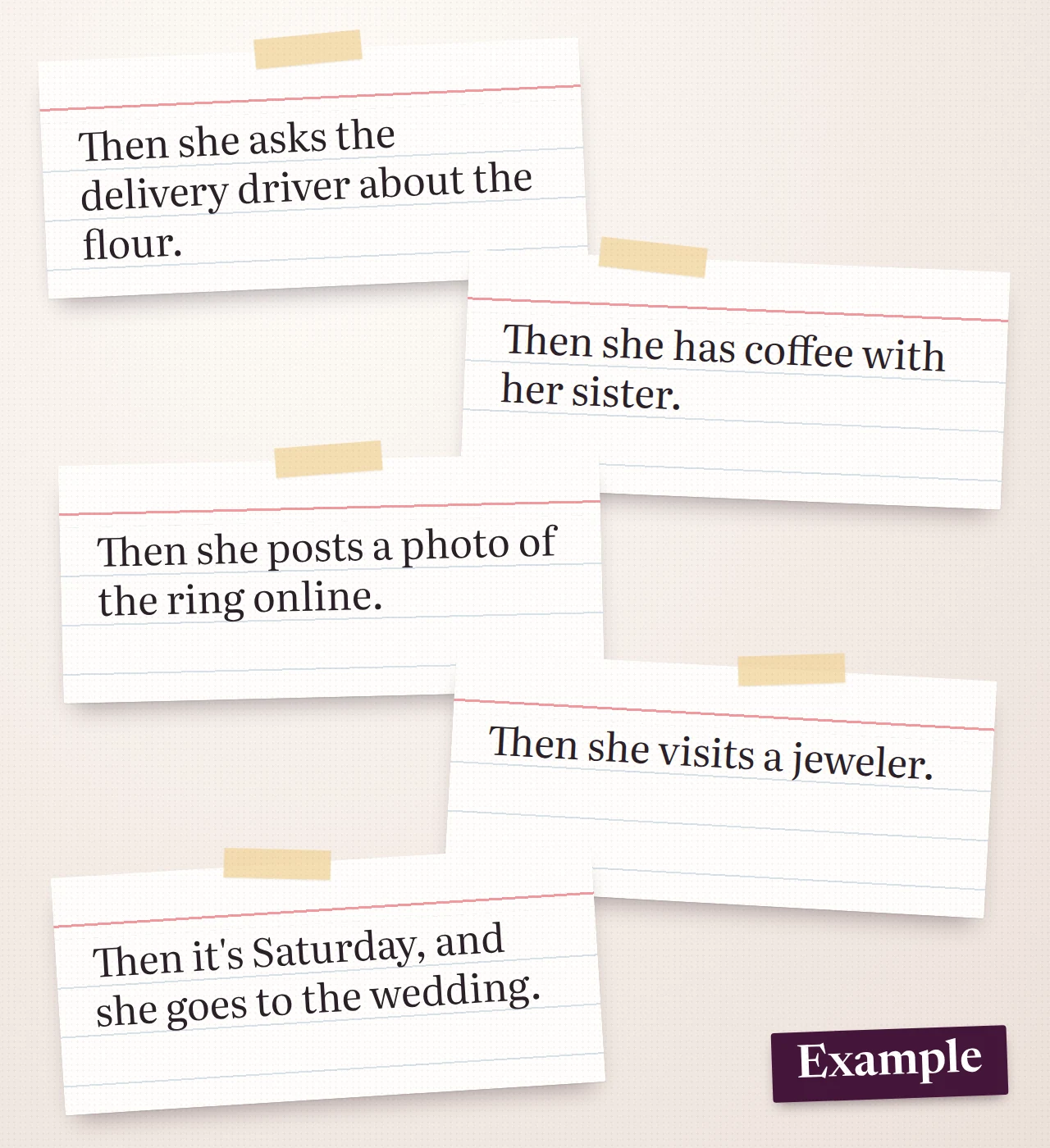
Example: a made-up story, written for this page.
A night-shift baker in a lake town finds a wedding ring in a sack of flour. That's the opening. The ending is the wedding, where she gives the ring back. Here's the kind of middle a first outline often gives her:
Every one of those could happen. Now swap scene 2 and scene 4. Cut scene 3. Does anything break?
Nothing does. That's the tell. When you can reorder or delete scenes in the middle and the story doesn't notice, those scenes aren't connected. They're just lined up. Readers feel that as a sag. Writers feel it as chapter nine.

A middle holds when each scene changes something, and that change forces the next scene.
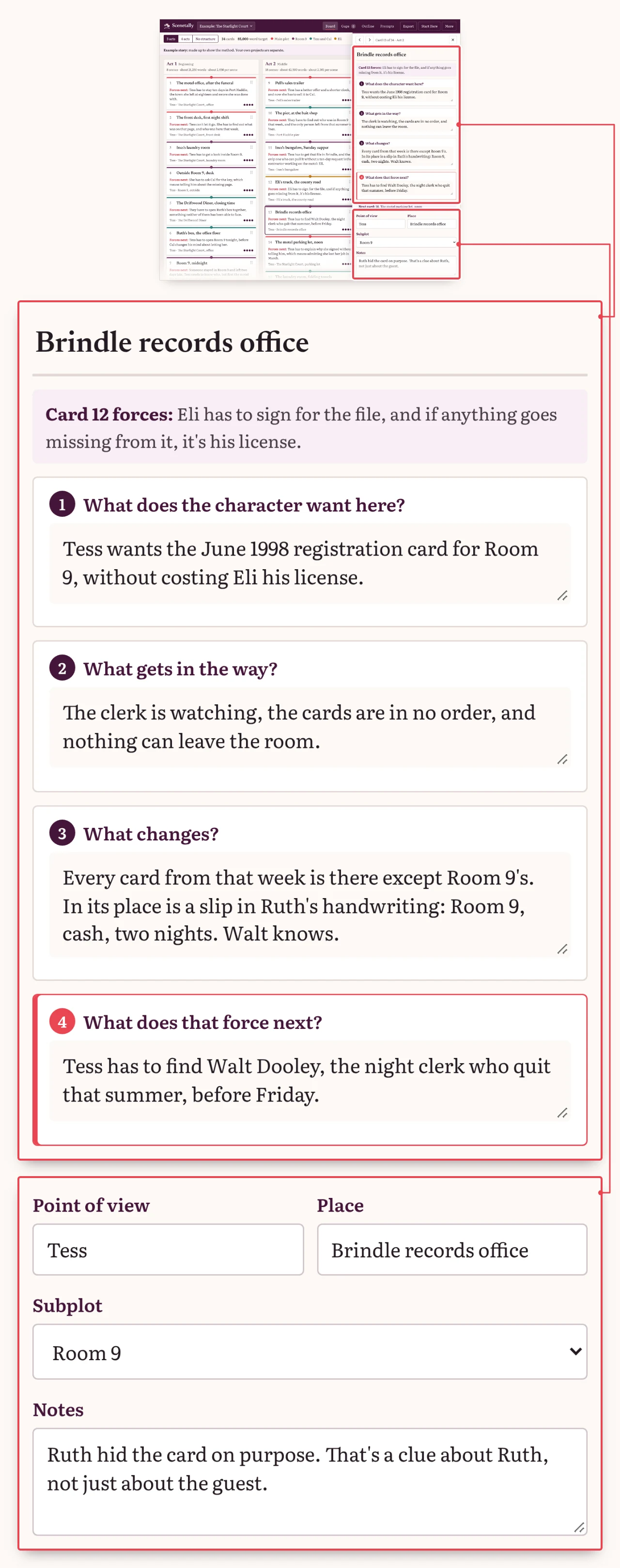
That's the whole method, and you can check it one card at a time. Every scene card on the Scenetally Plot Board asks the same four questions:
The first three keep a scene honest: someone wants something, something pushes back, and something is different when the scene ends. The fourth is the link. Whatever you write there is the reason the next card exists. If you can't write anything there, you've found the soft spot while it's still a card, not a chapter.
The questions don't pick your plot. They work the same for a cozy mystery or a space opera, with three acts, four, or none. They only ask whether each scene earns the next one.

Same baker, same ring, same opening and ending. In the new outline, cards 1 to 5 carry the opening, up to the ring in the flour, so the middle starts at card 6. Here are its first three cards. Each one has its four answers, and each fourth answer hands the next card its reason to exist. (Still a made-up example, written for this page.)
Run the swap test again. Cut card 7, and card 8 has nothing to stand on: no locked safe, no Tuesday shift list, no name for her sister to spot. Move card 8 in front of card 6, and Wren is reading a list nobody has handed her, from a mill she hasn't found yet. Each card needs what changed in the one before it. That's the difference between a middle that sags and a middle that pulls.
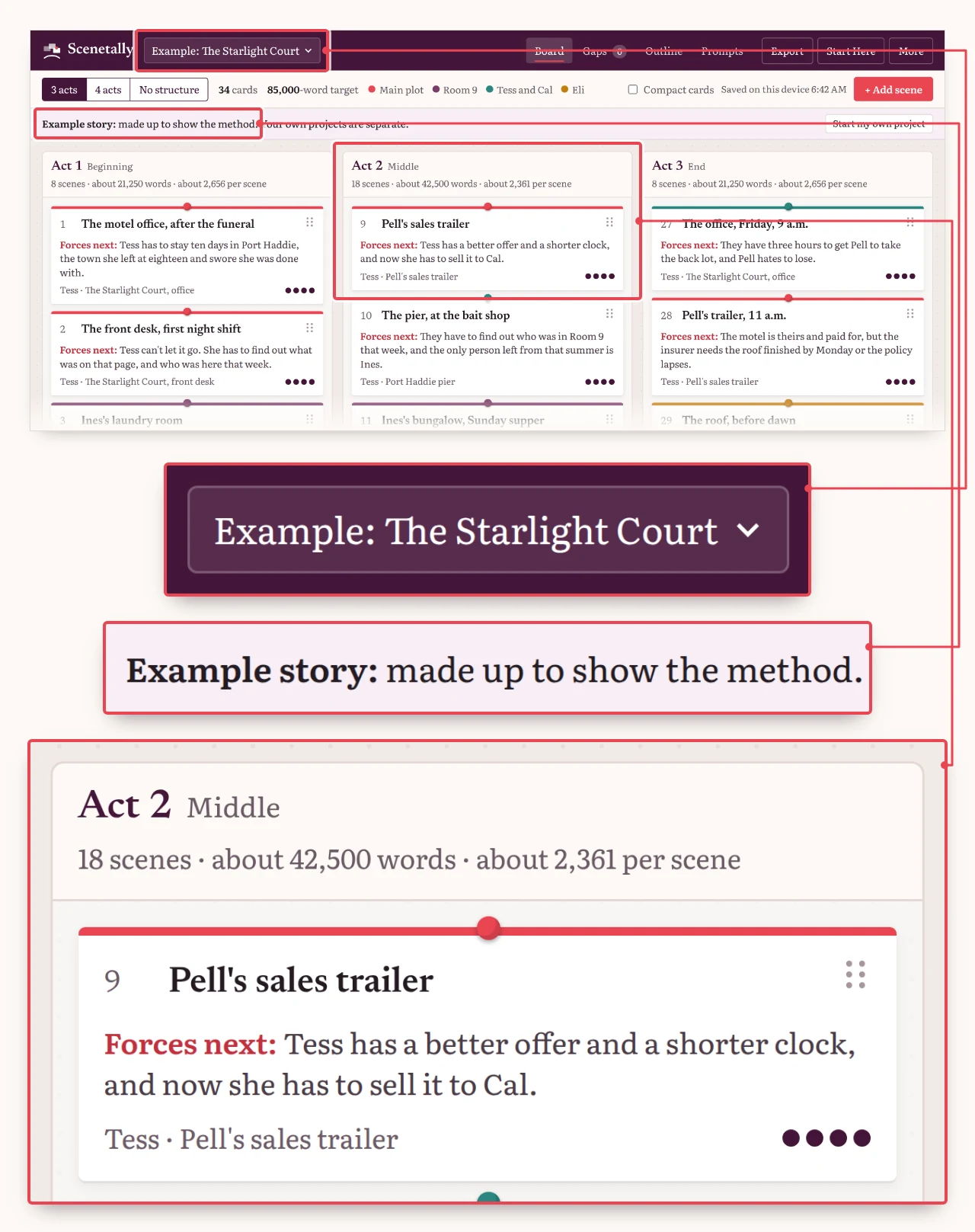
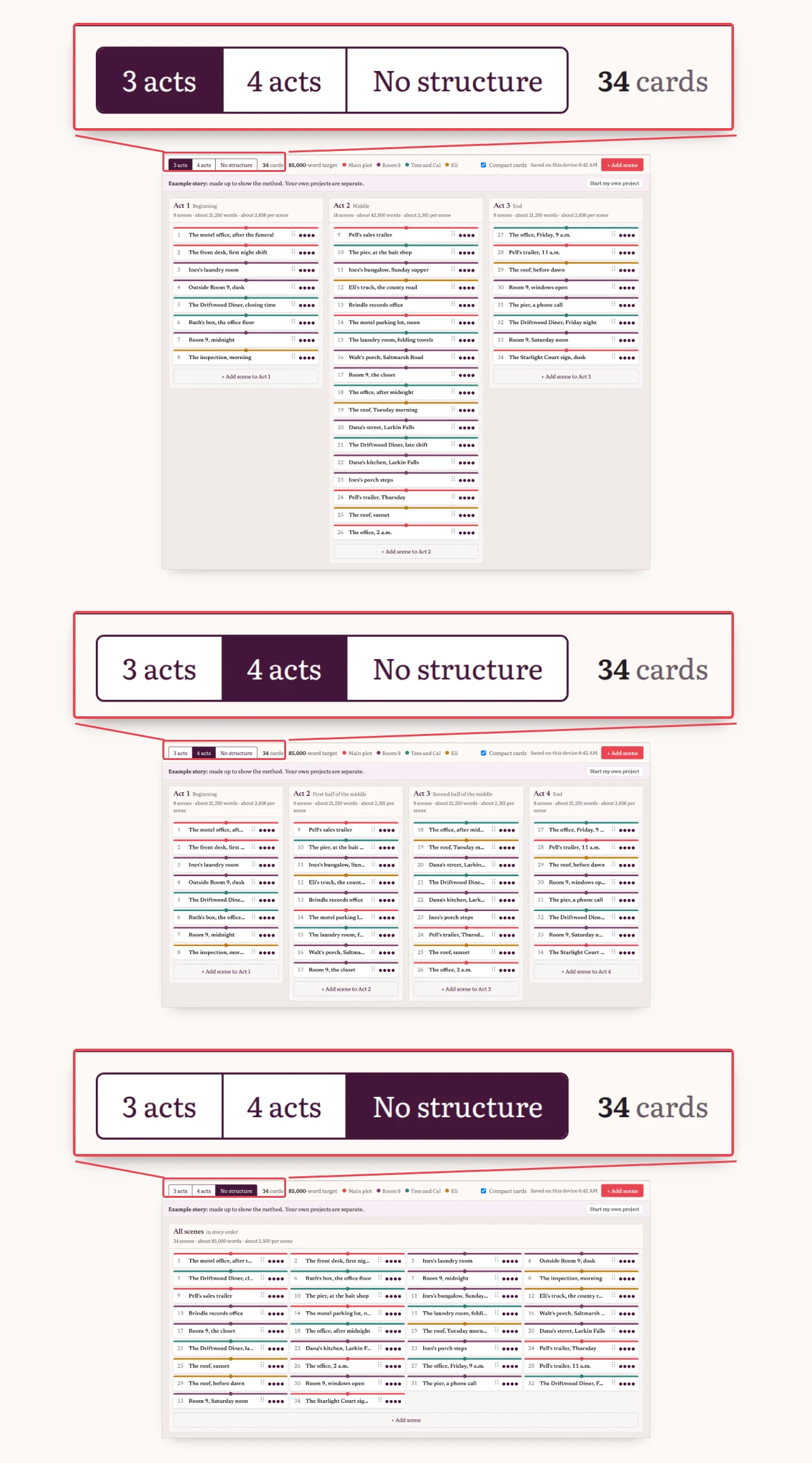
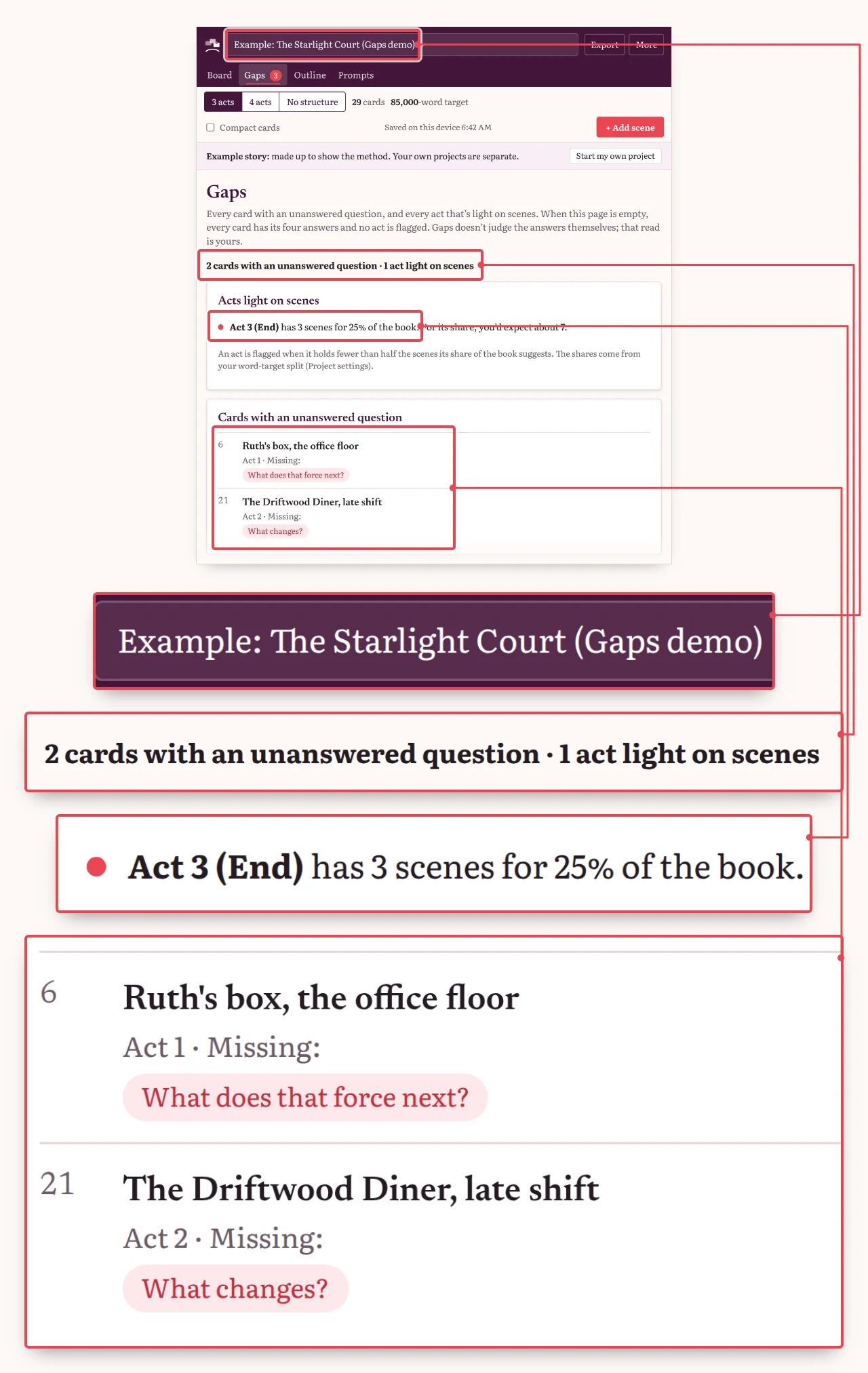
Here's the board itself, with the complete example story that comes with it: a card opened up, the Gaps view, and a switch from three acts to four and back, with every card still on the board.
Plot a few scenes on the board. If it's not for your story, email us within 30 days.
30-day money-back guarantee. Email support@scenetally.website within 30 days of purchase and we'll refund 100% of what you paid for that product. No questions asked.
When your outline is ready to leave the board, export it as a Word document (DOCX) or plain text, or print it. You can also save a backup file of every project whenever you like.
It's a fair worry. A structure template can make a story feel stiff.
Two things keep that from happening here. First, structure is optional. Pick 3 acts, 4 acts or none, and switch whenever you want; your cards stay on the board. Second, the questions don't choose anything for you. They ask what your character wants. You write the answer. Change your mind in chapter twelve? Change the card. An outline here is meant to move.
If you're a pantser, the board works after the fact, too. Some discovery writers draft first and plot later. Put each scene from your messy draft on a card, fill in the four answers, and the Gaps view shows you which scenes don't have them yet.

Outlining can turn into its own hobby. You add a character sheet, then a map, then another pass at act two, and the draft keeps waiting.
The Gaps view gives you a finish line you can see. It lists every card that still has an empty question and points out the acts that are light on scenes. When it's empty, every card has its four answers and no act is flagged. It can't tell you whether an answer is a good one; that read is yours. So once the list is empty, read your fourth answers in order. If each one sets up the card after it, that's a good moment to stop plotting and start drafting.

There are good free options, and we'd rather you hear it from us.
What you're paying for here isn't the board. It's the four questions on every card, the Gaps view, and a complete story plotted the same way, so you can watch the method work before you use it on yours.
If you already plot scene by scene and ask what each scene forces next, a free board may be all you need. That's fine.
It suits a writer who already has a story idea, a few scenes in view and the characters to carry them, and who has stalled in the middle or has been outlining for a long time without finishing.
It won't suit you if you want software that writes for you (Scenetally doesn't use AI), if you want someone to read and critique your manuscript, or if you'd rather not plan at all and want to keep it that way.
Plan to plot on a computer or a tablet. On a phone, you can read your outline and edit cards. Each device keeps its own board, and a backup file carries an outline from one device to another.
You'd judge an outline by reading it, not by who signed it. Do the same here. The example story comes loaded on the board with every card answered, and the video above shows it there. The board itself is new, so there are no reviews to point to yet.
Questions before you buy? Email support@scenetally.website.
One-time payment. No subscription. No recurring charges.
Open the example story, then start your own first card.
Instant access by email after purchase. Your downloaded files are yours to keep.
30-day money-back guarantee. Email support@scenetally.website within 30 days of purchase and we'll refund 100% of what you paid for that product. No questions asked.
No. Scenetally runs in your browser. After you buy, you open the board from your access page.
On the device you're using. Scenetally runs in your browser. Your outlines are saved on your device, not on our servers. Export or back them up anytime. Each browser on each device keeps its own board, so to move an outline from your laptop to your tablet, save a backup file on one and restore it on the other. Signing out of your access page doesn't delete your outlines. Clearing your browser data does, so save a backup file now and then.
The board is meant for a computer or a tablet. On a phone, you can read your outline and edit cards. The phone keeps its own board too, so restore a backup file there to bring an outline over.
Yes. Export it as a Word document (DOCX) or plain text, or print it.
The four questions work for any story with a character who wants something. If you'd like a head start by genre, you can add Genre Scene Decks at checkout for $12: 4 decks of 30 editable cards for romance, mystery and suspense, fantasy and adventure, and family and literary drama.
No. The board doesn't use AI, and it doesn't write for you. The prompts are a fixed list you browse and search.
No. It's an original story we made up to show the method, and it's labeled as an example. The three cards about the baker on this page are made up, too.
Put each scene on a card and fill in the four answers. The Gaps view shows you which scenes don't have them yet.
If we ever stop hosting the tools, we'll email you at least 60 days before and send you a copy that runs on your own computer.
Questions about using Scenetally? Email support@scenetally.website. We answer within 2 business days, for 12 months after your purchase.
Open it, click any card, and read the four answers. Then put your own opening on the first card of a new project and ask the same four questions. The fourth one tells you what the second card is about.